Milestone 2
Consists of two parts:
- HTLC + Vesting implementation
- Ad-hoc ledgers
verify-performmechanism PoC
HTLC + Vesting implementation
For this second milestone, we extended the HTLC contract implemented in MS1. By adding output validation, we allow the HTLC to enforce the creation of smart contract UTxOs during the claim operation. We also implemented a very simple vesting contact to use as an example of inter-head smart contract interaction.
The canonical use case for HTLCs, explained in MS1, require two parties interested in executing a transaction (Alice and Bob in our case). This way, the party that will receive the funds is in charge of generating the preimage and sharing the hash, the other party creates the HTLC. This dynamic is important, if there’s only a single party interested in making the transaction, the flow breaks, so, in order to maintain it, the example we choose is a vesting contract, where Alice is sending funds to Bob, but they will be unlocked at a future time. Bob can share the preimage once the funds are guaranteed by the HTLC 2.0 contract to be sent to the vesting address with the appropiate timeout.
HTLC 2.0 Improvements
We’ll list the changes made from the HTLC desing in MS1, anything not mentioned in this document is the same as the previous version, which you can read more in the corresponding section of the ms1 document.
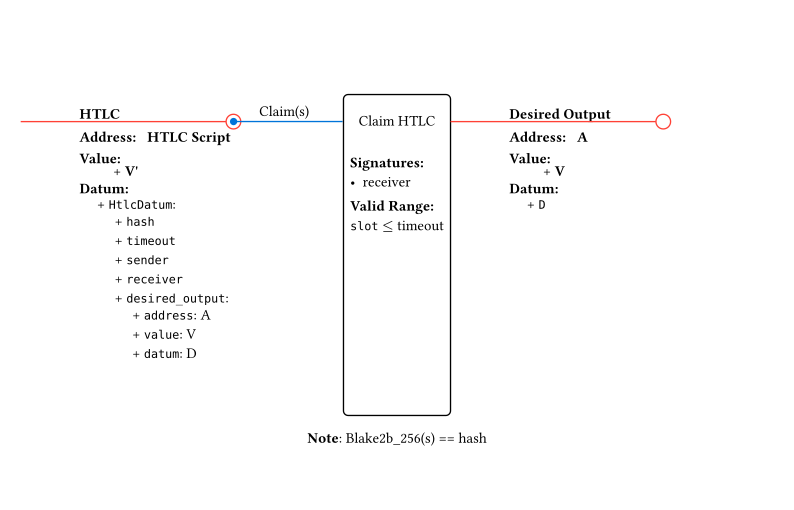
The first change was to add a new data type called DesiredOutput, this type represents everything we want to specify as the desired output when claiming the HTLC, including a non-opaque representation of a Value and an optional datum (if a datum is included, we force it to be Inline).
UTxO Specification
Datum
- hash: ByteString
- timeout: PosixTime
- sender: VerificationKeyHash
- receiver: VerificationKeyHash
- desired_output: DesiredOutput
DesiredOutput
- address: Address
- value: Pairs<PolicyId, Pairs<AssetName, Int>>
- datum: Option
HTLC Transactions
Claim funds
Consumes a HTLCUtxo with the Claim redeemer, providing the preimage of the stored hash. This transaction must be submited before the timeout, signed by the receiver and create the desired_output.
Vesting Contract
The vesting contract is a single validator with a single operation, “Claim”.
UTxOs Specification
VestingUTxO
Address
- Script address
Datum
vest_after: PosixTime
receiver: ByteArray
Value
- min ADA
- offered tokens
Vesting Transactions
Lock Funds
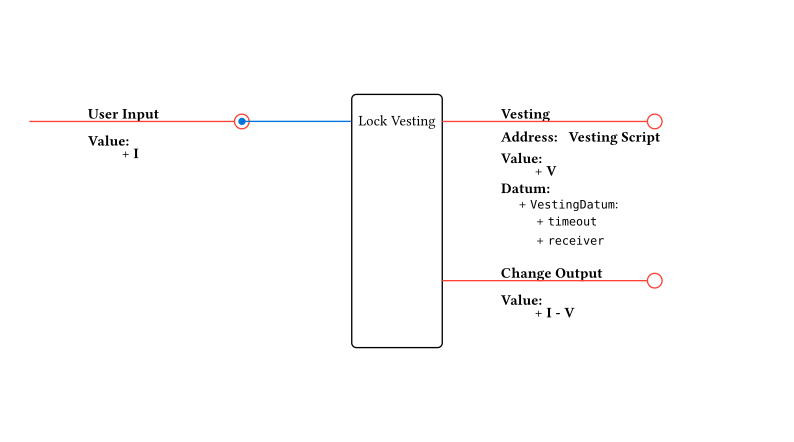
Creates a VestingUTxO containing the offered tokens. The datum specifies the “vest after” timeout in posix time from when the tokens become available to claim and the receiver that can claim them. This transaction has no validation, so the fields of the datum must be carefully considered. An invalid pubkeyhash or a timeout on the far future might make the UTxO unspendable.
Claim Vesting
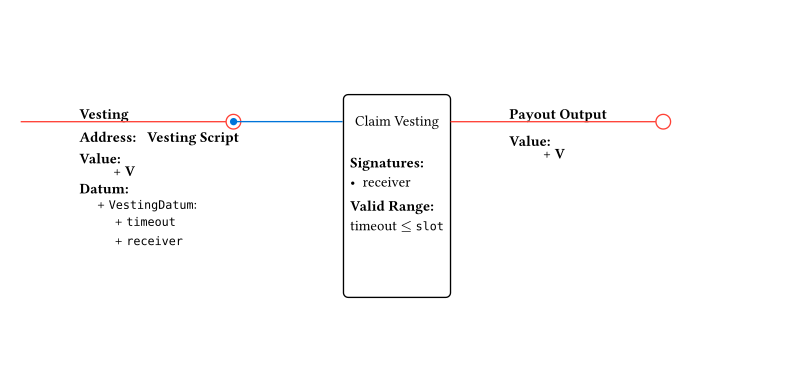
Consumes a VestingUTxO. This transaction should be submitted after the deadline and signed by the receiver.
Drawbacks of this design
As mentioned in the introduction, HTLCs still require two parties to be interested in the transaction taking place. For single party examples, like Alice wanting to place a bet in a lotery happening in another head, the preimage and hash management becomes fuzzy. This issue is demonstrated further when you take into account that Alice has no way to ensure that the HTLC UTxO that Ida created in Head B has the correct desired_output. For a single party example, this makes it a fully trusting protocol. For the dual party example, this is still not ideal. Bob could collude with Ida to make the timeout of the vesting UTxO shorter, or delete it altogether. A potential solution would involve making the desired_output field part of the hash, so the claim becomes impossible if this value is tampered with.
This solution sounds ideal, but the issue now becomes that the desired_output is not the same in Head A a in Head B. In Head B we want to create the vesting UTxO in the name of Bob for a future timeout, but in Head A, Ida would want to recover the assets as soon as possible without waiting and certainly without having to get Bob’s signature.
This design constraints will be discussed in more detail once we start to compare HTLCs with the Ad-hoc ledger approach.
Ah-hoc ledger verify-perform mechanism PoC
The main goal is to atomically execute a transaction original_transaction across two ledgers L₀ and L₁, resulting in spending UTxOs in L₀ and producing outputs in L₁ as if they were in the same logical ledger Lₚ, the ad-hoc ledger.
The requirements for the mechanism are:
- intermediaries need to verify that
original_transactioncan be executed, before the actual effects are performed on both ledgers - intermediaries shall be able to check wheter
original_transactioncould be applied on source ledger and target ledger (via collateralization). - the end result of the mechanism is either that the
original_transactionsis fully applied on both ledgers, or in none of them.
We’ll start with implementation ideas, with explanation of their respective limitations, challenges and future improvements.
Contract Design - Version 1
The mechanism is comprised of the following operations:
verify: verify a futureperformtransaction in this ledger.perform: perform the already-verified transaction.
Wrapped UTxOs
L2 users will send UTxOs to the Lp script address for making them available in the ad-hoc ledger.
- Address: Lₚ script
- Value: any
- Datum:
- owner: Address
- intermediaries: List[PublicKey]
Reserved UTxO
The state UTxO used to store the reserved wrapped UTxOs. Its NFT will be minted by the mint purpose of the Lp script.
- Address: Lₚ script
- Value: 1 NFT
- Datum:
- reserved_utxos: Map[TransactionHash, List[OutputRef]]
Lₚ script
-
Spend purpose redeemers:
- Verify
- Perform
-
Mint purpose redeemers:
- Data: for minting the Reserved UTxOs
-
No other purposes allowed
Operations overview
The verify operation will mark some specific UTxOs as reserved for a perform transaction, while disallowing the usage for other verify operations. The marked UTxOs list will be stored in the datum of a unique “state UTxO” for the ad-hoc ledger. By off-chain mechanisms, the UTxOs will be tagged with the perform transaction hash, and a set of privileged participants will cosign the transaction as a way to guarantee some level of security.
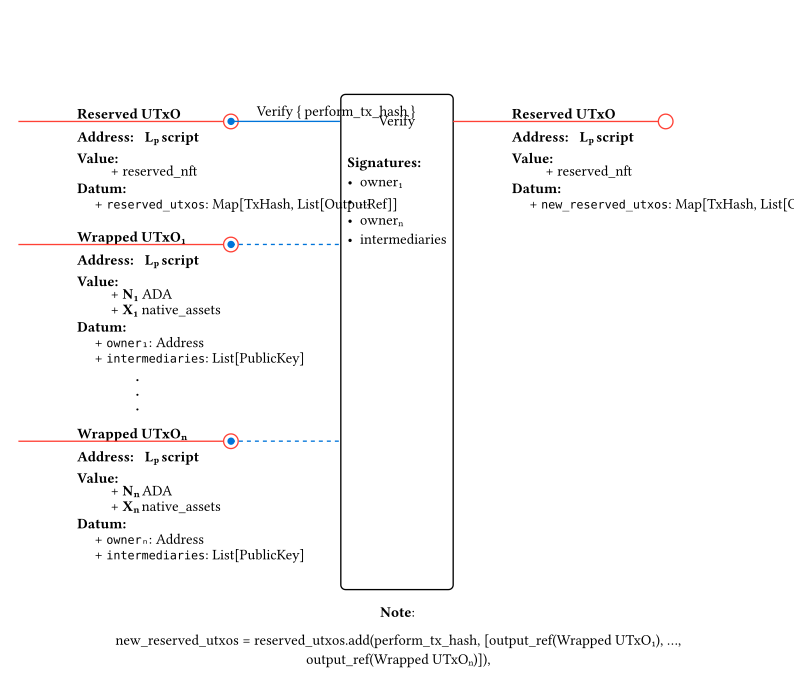
The perform operation will consume their reserved wrapped UTxOs, and validate its hash against the tag of those UTxOs.

As stated in the verify-perform mechanism description for ms1 deliverable, each L2s replica of the ad-hoc ledger must be semantically equivallent i.e. same UTxO set except their addresses, for ensuring no liquidity traps. This consistency, along with the correct ordering of the operations for atomicity, is ensured by the intermediaries cosigning the verify and perform transactions in each L2 replica.
Restrictions, Notes & Future Improvements
- Any piece of data that is needed for the
performoperation could not be related to theverifyoperation in any way, since we need to calculate theperformtx hash before building theverifytransaction.
This happens because if we relate a verify-perform pair by the perform transaction hash, we need to build the perform transaction before building the verify tx. This implies that the reserved UTxOs could not be spent in both transactions, nor the reserved UTxO datum could be updated in both transactions.
Even more, reserved UTxO datum could not be updated in the verify transaction only because it must be referenced in the perform transaction with the verify tx hash, which is unknown at the time of building the perform transaction body.
So, the core problem to solve is how to on-chain relate verify and perform transactions in order to ensure atomicity and consistency, taking into account the previous constraints.
-
The intermediaries might be a parameter of the Lₚ validator instead of being part of the reserved UTxOs datum?
-
How to relate on-chain Lₚ scripts from different heads? We might need a unique identifier mechanism, as proposed in the paper.
-
How to prevent intermediaries from cheating by doing verify-perform in only one head, whilst doing nothing in the other head? This might be a concern for the dispute mechanism proposed in the paper, and subject to further research in a coming milestone.
Contract Design - Version 2
We need a more flexible version in terms of the constraints regarding the relationship between the verify and perform transactions. So, we’ll do a very simple version that we’re sure that works, and add constraints in later versions for iteratively adding security and decentralization guarantees.
In this version, the verify will consume the UTxOs meant to be inputs to the perform transaction, add them a specific “validity token” that could be recognized by the perform transaction. Then, perform will consume the UTxOs and burn those tokens.
This way, we offload to the intermediaries the responsability of doing the proper inspection and execution of both the verify and perform transactions. Later version must favour on-chain code over intermediaries supervision.
Wrapped UTxOs
Same as Version 1.
Lₚ script
-
Spend purpose redeemers:
- Verify
- Perform
-
Mint purpose redeemers:
- MintVerified: for minting validity tokens. This tokens “reserve” the UTxOs for a future
performtransaction. - BurnVerified: for burning validity tokens.
- MintVerified: for minting validity tokens. This tokens “reserve” the UTxOs for a future
-
No other purposes allowed
Operations overview
The verify operation will consume the UTxOs meant to be inputs to the perform transaction, add them a specific “validity token” that could be recognized by the perform transaction. Then, perform will consume the UTxOs and burn those tokens.
Let’s consider the example of applying the mechanism for wrapping a UTxO.
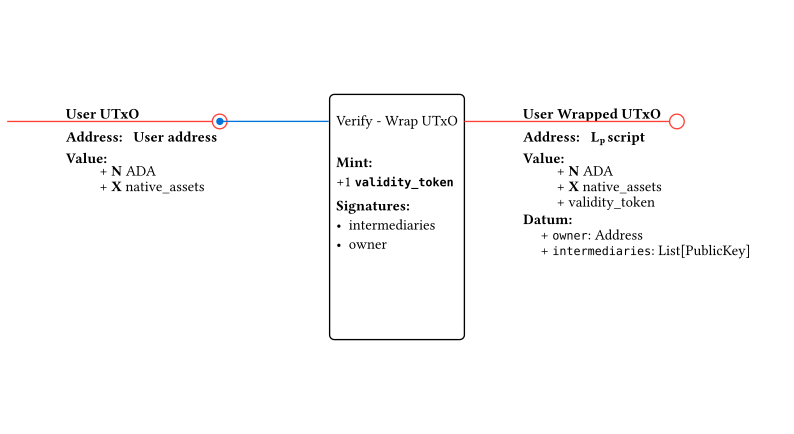
verify consumes the User UTxO and adds a validity token to it, meaning is reserved for the perform transaction.
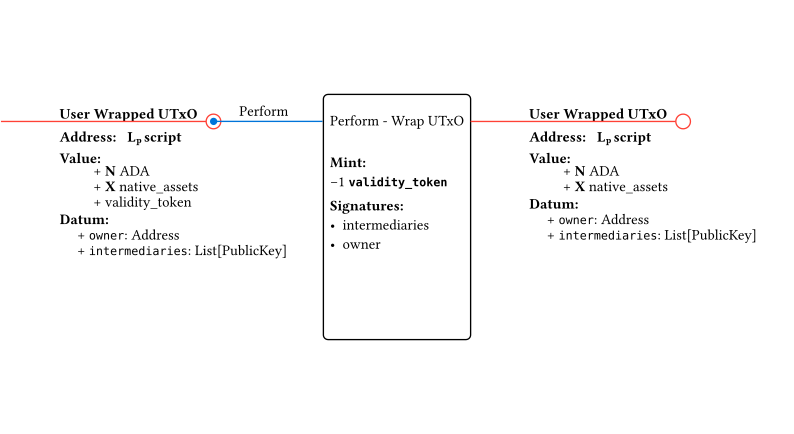
Then, perform consumes the User Wrapped UTxO and burns the validity token, meaning the UTxO is available within the Lₚ script for other operations. These other operations must also use this mechanism to ensure atomicity.
Notes & Future Improvements
-
There’s no constraint that explicitly relates a pair of
verifyandperformtransactions. A non-scalable approach might be to restrict the mechanism to only oneverifyhappening at a time, with eachverifyhaving a very short timeout for theperformtransaction to be executed. Resolving this on-chain is quite neccessary for being a robust mechanism. -
Also, the constraint of actually doing the
performthat the intermediaries and owners agreed about inverifyis not enforced by this implementation. This is delegated to the good faith of intermediaries. We must tighten this solution to match the requirement in a future enhancement as well. -
Add unique identifier mechanism to relate the “same” Lₚ script from different heads.
-
Add collateral slashing tracking between intermediaries, for answering: how much of the value of each collateral UTxO is from each intermediary?
Contract Design - Version 3
A middle-ground between Version 1 and Version 2.
For solving the problem posed by Version 1 of circularity happening by relating a verify-perform pair with the perform transaction hash, we must break it. This can be achieved by
- labeling the reserved inputs with a token, or with some other mechanism as in Version 2. This avoids
verifydouble-spending as well. Another option is to trust the intermediaries on not verifying more transactions than the ones they’re cappable of performing with the available inputs. - create a spec for the expected
performtransaction outputs: spec for the original transaction outputs.
The outputs spec definition and usage is challenging, but we can think of using the transaction redeemers to pass that information.
- pass by redeemer the expected
performoutputs spec toverify.verifycollects inputs, validates that is possible to produce theperformoutputs from them, and reserves those inputs by attaching a token (as in Version 2). performjust collects those reserved inputs, burn their marker tokens (in case of using tokens) and produces the outputs.
Then, there’s still an issue to resolve: how do we ensure that perform actually consumes the verify-marked inputs and produces the expected outputs?
A possible solution might be to produce a hash from the outputs spec, and use it as the token name of the verify-minted tokens, which in turn are attached to the marked inputs. Then, in perform we burn those tokens and validate that hashing the produced outputs matches the name of the tokens being burnt. This way, we relate a pair of verify-perform while avoiding clashes between distinct verify’s.